A map is a tool used to simplify reality.
But when we reduce something to a map, we need to grasp this fact: the map is not the territory.
A map is necessary, but not sufficient to construct reality. A map needs interpretation.
And this is where its problem lies; there is miscommunication when we see different realities.

How does this apply to Software sales?
During the request for proposal (RFP) process, customers share their proposals and requirements for the solution.
You judge the proposal using your own lens, and based on your evaluation of what they say.
Then, you build a business case around the interpreted proposal.
But there is often a mismatch.
The proposals are often subject to different interpretations among different people.
Imagine a game of charades, played out in real life.
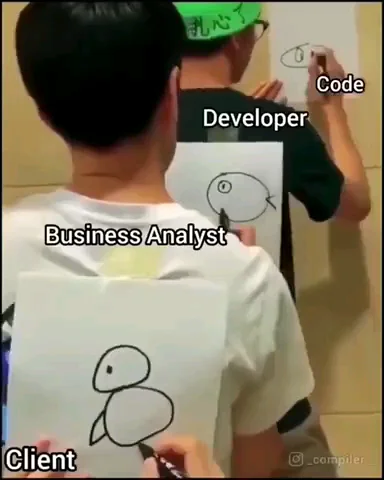
How can we do better?
Check with the customer along the way.
Build small blocks and return to the customer to verify if our territory matches their mental map.
Sometimes, the customer might not know what they don’t know.
The map they painted might not be a good version of reality, of what they really need.
Put yourself in the shoes of the customer and help them to fine-tune their map.
Paint an accurate image of what are their options available based on their current solution landscape.
How does this apply to Finance and Investing?
The concept of “the map is not the territory” also applies to finance and investing.
Statistical models like discounted cash-flow (DCF) is commonly used to analyse the intrinsic value of a stock.
But the model does have its flaws.
Our estimates may be based on historical data. And we have to make assumptions of the growth rate and discount rate, which are all subject to different interpretations. Rubbish in, rubbish out.
A model might show you some risks, but not the risks of using it. Moreover, models are built on a finite set of parameters, while reality affords us infinite sources of risks. – Nassim Taleb
Financial models are built on a set of pre-determined and finite set of parameters.
But reality offers us an infinite source of risks.
In reality, there are black swan events.
Events that are highly unpredictable, with severe repercussions.
These black swan events are underestimated; we trivialise the magnitude of its impact and the second-order effects.
And unanticipated; we could never fully prepare ourselves for them. Take for example, the Covid-19 pandemic and stock market crash.
How can we do better?
Recognise the different contexts when a map is useful and its limitations.
You do not understand a model or map unless you understand its limitations.
Some models might be more useful than others depending on the type of company, industry and business cycles.
For example, using a DCF model is only effective if the company is able to generate positive and constant future cash flow.
Perform several valuations using different models if necessary.
Recognise that worst-case scenarios happen and the “map” is not perfect.
Stress-test your portfolio and ensure an adequate margin of safety.
Building Your Range of Mental Models
The map is not the territory.
And one map is not enough.
If you rely solely on one map or model to understand reality, expect disaster will happen.
Imagine solving all your problems with only the same, one tool (e.g. one framework or valuation model).
You are bound to run into the problem of a-man-with-a-hammer tendency.
To every man with only a hammer, everything looks like a nail.
To be an expert in decision-making and solving problems, do not rely on one map.
Instead, build up your range of mental models in your mind.
This way, you will have multiple maps to navigate whatever problem reality throws at you.