This is Marketing by Seth Godin provides bite-sized chunks of useful marketing insights. It breaks myths about marketing. Marketing is not about pushy sales. Marketing is not advertising. Marketing is about empathy and service, understanding your customers and building a tribe.
The author’s narrative style makes it easy to comprehend. Lined with case studies and short stories to illustrate learning points. However, if you are looking for in-depth research with footnotes, you might not find the examples impactful. The book could also have a stronger, more coherent narrative structure.
Overall, This is Marketing provides actionable advice on how to improve your marketing and build ideas that spread. Here are key takeaways from the book “This is Marketing”:
A Simple Promise
Marketing is not sales. Marketing is not advertising. What exactly is marketing? In one word, marketing is a promise.
To develop a marketing promise, Seth Godin asks us to fill in these blanks:
- “My product is for people who believe __________.”
- “I will focus on people who want __________.”
- I promise that engaging with what I make will help you get __________.”
What promises are you making? Are you living up to these promises?
Build something worth it
Contrary to what most might think, inventing a good product is not simply up to the job of the design or manufacturing team. Marketing begins right at the start, from the stage of coming up with the product itself.
Marketing in 5 Steps:
- Invent something worth it
- Design and build it such that few people will particularly benefit and care about
- Tell a story to the smallest viable market
- Spread the word
- Show up regularly
To build something worth it, you have to dig deeper and understand people’s underlying needs. Is your product or service fulfilling some fundamental needs?
As Harvard marketing professor Theodore Levitt famously pointed out, nobody wants a quarter-inch drill bit for its own sake; they want it for the quarter-inch hole it makes.
But no one wants a hole for its own sake, either. It’s just a way to achieve something else, such as installing a shelf in the living room. And that shelf is just for storage purposes, a way to make your house look neat and tidy.
And why do you want a tidy living room? Well, perhaps it makes you feel that you have control of your environment. Or maybe when visitors come over, they would admire you for keeping your house tidy.
In other words, you don’t really want a drill bit. You want safety and respect – two of the most fundamental human needs. The drill bit is just a tool for fulfilling your core needs.
Key learning point: Find out your audience’s aspirations and deep-seated needs. Build a product/service which matches their underlying needs and desires.
Find the Smallest Viable Market
Don’t go after everyone. Mass market pleases everyone, which leads to average and mediocrity.
Focus on finding your smallest viable audience, which you can serve the best.
Value Positioning
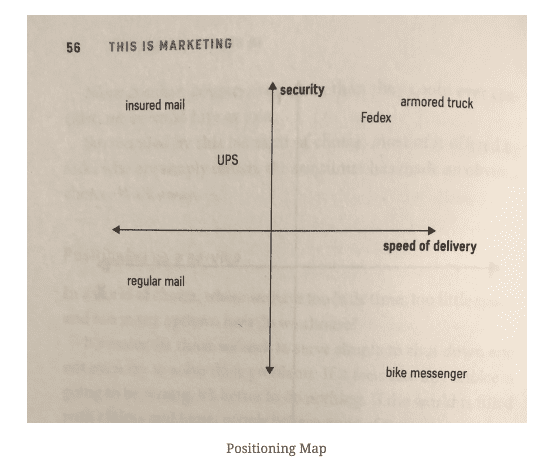
How to find your product’s positioning:
- Identify 2 common attributes your customers care about the most
- Position these attributes each on the X-axis and Y-axis
- Find out where competitors lie, and where you lie in the quadrant
Key Learning point: Don’t stay in the middle. Go to the extremes. Find an edge. Find the unique positioning for your product.
Status, dominion and affiliation
We spend a lot of time paying attention to status. It affects our everyday decisions, such as, which restaurant to dine at? Why drive this car and not the other?
Broadly, when it comes to status, there are 2 types of people. Those who care about dominating the rest, “I’m better”, vs those who seek affiliation, “I’m part of your family”.
- Dominion: Status that comes from being at the top of the hierarchy
- Affiliation: Status that comes from the community
To better serve your customers, you have to find out which narrative they resonate with.
Dominance is vertical. It is about where you stand in the pecking order, who is above/below me?
Affiliation is horizontal. It is about connecting with others, who is standing next to me?
Affiliation is not as focused on scarcity, compared to dominion. Affiliation admires the network effect. For instance, the fashion industry is usually about affiliation. What is everyone else wearing? Is this in the season? Customers want to be affiliated with one another. The goal is to be part of the group, not to win.
Key Learning point: Affiliation or dominance is up to the customer not you. Understand the worldview of those you seek to serve, and send the right signals to your audience.
The Funnel
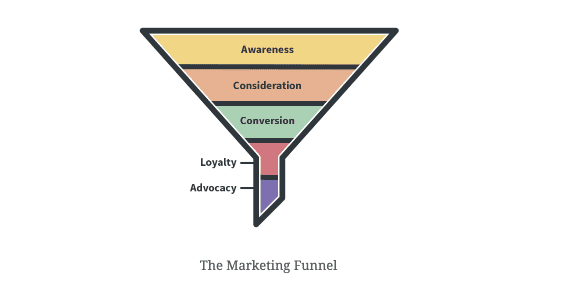
Imagine you are running a marketing campaign for your business to increase awareness of your brand. You decided to buy Facebook ads which costs $1,000. It reaches 1 million people and you’ve received 20 clicks.
Do some simple math, and find out that Cost per Click (CPC) = $50.
Assuming 1 out of 10 people buy your product, 1 order is going to cost you $500.
If your customer LTV is >$500, you can afford to buy more ads to get more customers at the same cost.
If your customer LTV is <$500, you need better ads or a better business.
Focus on the TOP of the funnel. Improve the quality of your leads and the efficiency of the process.
Key Learning point: If you can’t see the funnel, don’t buy the ads. If you can’t measure the funnel, and it costs too much to afford the ads, don’t buy the ads first. Fix the funnel first.
Summary of Key Points:
Marketing has changed, and our understanding of what to do has to keep up. With the rise of the internet and the fall of traditional mass media, marketers can no longer rely on advertising alone. Instead, effective marketing depends on empathy and service.
This means developing a product that fulfils people’s underlying needs and desires. Finding a unique value-positioning for your product, and telling stories to the smallest viable market which you can serve best. Marketers should create and relieve tension by challenging their statuses and focus on improving the top of the funnel.
Thank you for taking the time to read my blog.
Enjoying the content so far? I post articles relating to business, investing, personal finance and self-development.
If you are interested in any of these topics, do subscribe to stay updated of new posts.